Territorial Gambit: Washington Mulls Sovereignty Claim Over Hormuz as IRGC Reasserts Closure
President Donald Trump has escalated regional tensions by suggesting the Strait of Hormuz could be declared U.S. territory, while Tehran insists the waterway remains under its 'decisive' control.

Your ad here — 728×90 banner space
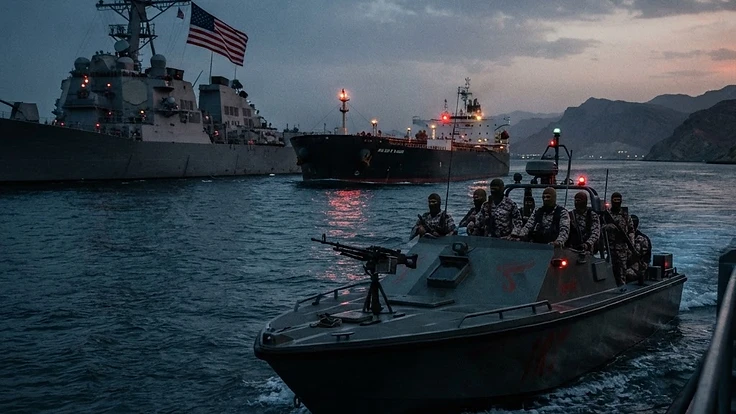
In a significant escalation of the ongoing maritime standoff, President Donald Trump has asserted that the United States maintains "total control" over the Strait of Hormuz and may seek to declare the vital waterway as U.S. territory. Speaking at an event in New York on Friday, August 14, 2026, Trump stated that following a victory over Iranian influence, he would move to formalize U.S. sovereignty over the strait to ensure global energy security. "After we finish defeating Iran, which is being very badly defeated, pretty soon I'll be declaring the Hormuz strait a territory of the United States," the President told reporters.\n\nThe White House's rhetoric coincides with a declaration from U.S. Defense Secretary Pete Hegseth, who confirmed that the U.S. military is fully prepared to maintain a naval blockade of Iranian ports "indefinitely." This stance marks a departure from earlier administration predictions that suggested a swift resolution to the conflict. Hegseth dismissed reports of deteriorating conditions aboard the aircraft carrier USS Abraham Lincoln, framing the U.S. naval presence as a cornerstone of a long-term strategy to bankrupt the Iranian regime. The carrier has reportedly faced logistical challenges, including plumbing issues and supply shortages, yet the Pentagon maintains its operational readiness is uncompromised.\n\nTehran has responded with defiance. Islamic Revolutionary Guard Corps (IRGC) Navy Commander Ali Azami posted on social media that the "Strait of Hormuz is closed," emphasizing that Iranian control over all vessel movements is "complete and decisive." This was echoed by Deputy Foreign Minister for Legal and International Affairs Kazem Gharibabadi, who remarked that the strait "cannot be seized by tweet, nor by aircraft carrier, nor by issuing an order." The diplomatic gridlock follows the collapse of a short-lived ceasefire agreement initiated in June, which failed to normalize shipping traffic.\n\nThe strategic implications of a U.S. territorial claim are unprecedented in modern maritime law. Analysts at Hormuz Sentinel note that such a move would likely be challenged by international bodies, but the immediate tactical reality is a heavily militarized corridor where transit has slowed to a trickle. On Thursday, ship-tracking data showed only nine vessels passing through the narrow entrance to the Gulf—a sharp decline from the pre-war daily average of over 130 ships. While some vessels attempt to transit with transponders off, the IRGC has demonstrated its ability to detect and strike non-authorized traffic, as seen in the recent attacks on commercial tankers affiliated with the United Arab Emirates. The situation remains a volatile stalemate with no clear diplomatic exit.
Related Intel

Tehran Outlines Formal Exclusion Zone Around Hormuz to Counter US Blockade
Iranian security officials have announced imminent plans to implement an operational maritime exclusion zone stretching from the U.S. naval blockade perimeter directly across the Strait of Hormuz.

US Neutralizes IRGC Tankers off Kharg Island as Diplomatic Narrative Fractures
U.S. Central Command disabled three Iranian crude carriers over the weekend following IRGC missile launches against American warships, escalating the maritime conflict into its seventh month.

CENTCOM Destroys Iranian Tankers and Coastal Launch Sites as Tehran Claims Drone Intercepts
U.S. Central Command struck three Iranian oil tankers and pre-positioned coastal minelaying missile platforms, while Tehran claimed to strike an unmanned American naval vessel in contested Hormuz waters.