Retaliatory Precision: Israel Strikes Beirut Target Following Majdal Shams Attack
The Israeli Defense Forces conducted a targeted strike in Beirut on Tuesday, aimed at a senior Hezbollah commander allegedly responsible for the weekend's deadly rocket attack in the Golan Heights.

Your ad here — 728×90 banner space
Targeted Strike in Southern Beirut
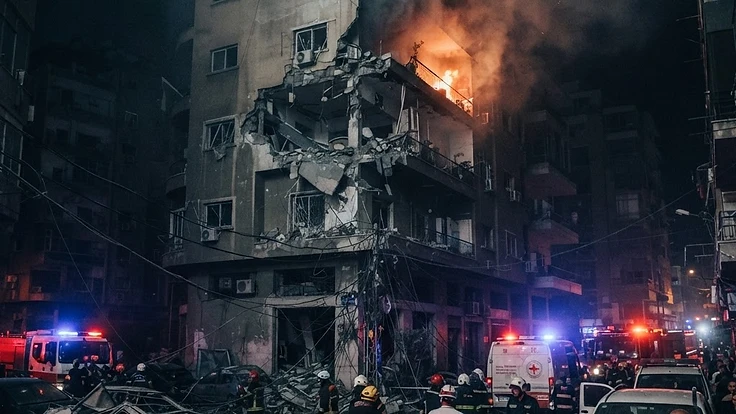
In a significant escalation of the ongoing regional friction, the Israeli Defense Forces (IDF) confirmed on Tuesday that they carried out a precision strike in the Dahiyeh district of southern Beirut. The operation targeted Fuad Shukr, also known as Hajj Mohsin, a senior advisor to Hezbollah Secretary-General Hassan Nasrallah and the head of the group's strategic unit. Israel identified Shukr as the operative responsible for the Majdal Shams rocket strike on Saturday, which resulted in the deaths of 12 children and teenagers.
Following the strike, the Lebanese Ministry of Public Health reported at least one death and several injuries, while Lebanese state media confirmed that the attack hit a building adjacent to the Bahman Hospital. The IDF characterized the mission as a direct response to the 'murder of children' and the ongoing projectiles launched from Lebanon toward Israeli territory.
Strategic Implications for the 'Axis of Resistance'
This strike represents the most daring Israeli operation in the Lebanese capital since January, when Hamas leader Saleh al-Arouri was assassinated in the same district. It signifies a calculated risk by the Netanyahu administration, testing the threshold of Hezbollah’s 'red lines' regarding strikes on Beirut. Iranian officials have previously warned that any attack on Lebanese soil, particularly the capital, would be met with a severe and disproportionate response.
Tehran’s Ministry of Foreign Affairs condemned the strike as a 'blatant violation of Lebanese sovereignty.' The regional intelligence community is now closely monitoring the 'Axis of Resistance' for a coordinated response. Historically, Hezbollah has retaliated for high-level assassinations by increasing the range and depth of its rocket fire into Israel, often targeting sensitive military or industrial infrastructure in the Haifa bay area.
US Diplomatic Efforts Scramble to Contain Sprawl
While Israel conducted the strike, US diplomatic channels remained active. White House officials, including National Security Communications Advisor John Kirby, had previously stated that while Israel has a right to defend itself, the US does not believe an all-out war is inevitable. However, the strike on a sovereign capital complicates the Biden administration's efforts to prevent a multi-front regional conflagration.
As of Tuesday afternoon, the United States has not moved additional assets to the immediate vicinity beyond those already deployed to the Eastern Mediterranean, but the USS Theodore Roosevelt carrier strike group remains on high alert in the Gulf of Oman. The primary concern for global shipping and energy markets remains the potential for Hezbollah to target Israeli offshore gas rigs or for Iran to disrupt transit through the Strait of Hormuz in a show of solidarity.
Related Intel

Tehran Outlines Formal Exclusion Zone Around Hormuz to Counter US Blockade
Iranian security officials have announced imminent plans to implement an operational maritime exclusion zone stretching from the U.S. naval blockade perimeter directly across the Strait of Hormuz.

US Neutralizes IRGC Tankers off Kharg Island as Diplomatic Narrative Fractures
U.S. Central Command disabled three Iranian crude carriers over the weekend following IRGC missile launches against American warships, escalating the maritime conflict into its seventh month.

CENTCOM Destroys Iranian Tankers and Coastal Launch Sites as Tehran Claims Drone Intercepts
U.S. Central Command struck three Iranian oil tankers and pre-positioned coastal minelaying missile platforms, while Tehran claimed to strike an unmanned American naval vessel in contested Hormuz waters.