Nasrallah Vows Inevitable Response Following Israeli Strike in Beirut
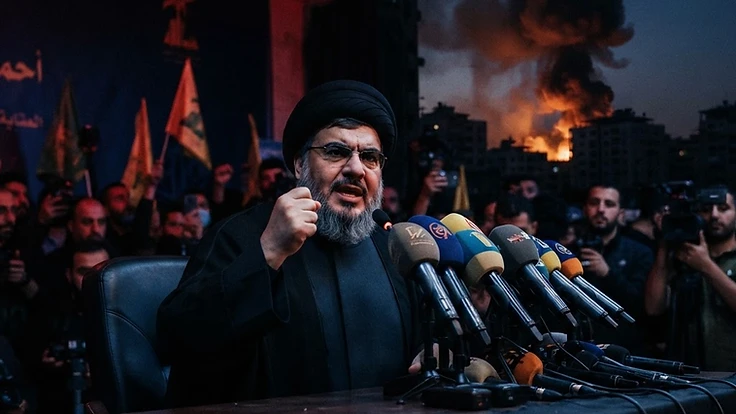
Hezbollah Secretary-General Hassan Nasrallah declared that the conflict with Israel has entered a new phase, promising a definite response to the assassination of Fuad Shukr.

Your ad here — 728×90 banner space
In a highly anticipated televised address following the funeral of senior commander Fuad Shukr, Hezbollah Secretary-General Hassan Nasrallah signaled a significant escalation in the group's confrontation with Israel. Speaking to thousands of mourners in Beirut’s southern suburbs via video link, Nasrallah stated that the assassination of Shukr, along with the subsequent killing of Hamas political leader Ismail Haniyeh in Tehran, has crossed red lines that make a retaliatory strike 'inevitable.' The Hezbollah leader emphasized that the conflict has transitioned from a support front for Gaza into a 'major open battle' spanning multiple borders. The Israeli strike on July 30, which targeted a residential building in the Haret Hreik neighborhood, resulted in the deaths of Shukr, an Iranian military adviser, and five civilians, including two children. Nasrallah dismissed claims that Hezbollah was responsible for the Majdal Shams rocket attack that killed 12 youths, which Israel cited as the justification for the Beirut strike. Regional intelligence suggests that Hezbollah is currently coordinating with the 'Axis of Resistance,' including the Islamic Revolutionary Guard Corps (IRGC) and Houthi rebels in Yemen, to calibrate a multi-pronged response. Nasrallah’s rhetoric suggested that the group is no longer bound by previous rules of engagement, stating that Israel must expect 'rage and revenge on all the fronts.' US officials have spent the last 24 hours engaged in feverish diplomacy to limit the scope of this promised retaliation, fearing that a strike on a major Israeli population center could trigger a full-scale regional war. Despite the fiery rhetoric, Nasrallah did not provide a specific timeline or target, maintaining a strategy of psychological pressure. Israeli Defense Forces (IDF) remain at their highest state of alert, with GPS disruptions reported across central Israel and the northern border regions reinforced with additional battery units. The international community is now focused on whether Iran and Hezbollah will launch a synchronized attack or if the groups will operate independently to complicate Israeli air defense calculations. The rhetoric from Beirut confirms that the window for immediate de-escalation has closed, leaving the region in a state of high-tension anticipation for the next phase of the conflict.
Related Intel

Tehran Outlines Formal Exclusion Zone Around Hormuz to Counter US Blockade
Iranian security officials have announced imminent plans to implement an operational maritime exclusion zone stretching from the U.S. naval blockade perimeter directly across the Strait of Hormuz.

US Neutralizes IRGC Tankers off Kharg Island as Diplomatic Narrative Fractures
U.S. Central Command disabled three Iranian crude carriers over the weekend following IRGC missile launches against American warships, escalating the maritime conflict into its seventh month.

CENTCOM Destroys Iranian Tankers and Coastal Launch Sites as Tehran Claims Drone Intercepts
U.S. Central Command struck three Iranian oil tankers and pre-positioned coastal minelaying missile platforms, while Tehran claimed to strike an unmanned American naval vessel in contested Hormuz waters.