Regional Stability Tested as Israel-Hezbollah Exchange Marks Major Escalation
Following a massive exchange of fire between Israel and Hezbollah, the U.S. continues to bolster its regional presence to prevent a full-scale Iranian involvement.
Your ad here — 728×90 banner space
The Middle East remains on a knife-edge following Sunday’s significant military escalation between Israel and the Lebanese militant group Hezbollah. The Israeli Defense Forces (IDF) launched what they termed a 'preemptive strike' involving over 100 fighter jets targeting thousands of rocket launcher barrels in southern Lebanon. Hezbollah responded by launching more than 320 Katyusha rockets and a swarm of explosive drones aimed at eleven Israeli military bases. While both sides have signaled a desire to avoid an immediate full-scale war, the intensity of the exchange marks the most dangerous flashpoint since October 2023.\n\nU.S. Air Force General C.Q. Brown, Chairman of the Joint Chiefs of Staff, arrived in Israel on Monday to meet with top defense officials, including Defense Minister Yoav Gallant and IDF Chief of Staff Herzi Halevi. The visit is a clear signal of U.S. commitment to Israeli defense while simultaneously serving as a diplomatic lever to urge restraint. The U.S. Pentagon has maintained a carrier strike group and a guided-missile submarine in the region to deter Tehran from launching a direct retaliatory strike for the July assassination of Hamas leader Ismail Haniyeh. Iranian officials have characterized the Hezbollah operation as a 'resounding success' that bypassed Israel's Iron Dome defenses. Foreign Minister Abbas Araghchi stated on social media that Iran’s response to the violation of its sovereignty would be 'definite, calculated, and well-managed,' suggesting that Tehran is closely watching the outcome of Hezbollah’s strikes before committing to its own kinetic action.\n\nFor market observers and shipping interests in the Strait of Hormuz, the primary concern remains the potential for the conflict to expand beyond the 'Blue Line' and involve Iranian assets. While shipping insurance premiums in the Strait have remained relatively stable over the last 48 hours, the threat of Iranian interference with commercial traffic as a retaliatory measure remains the 'black swan' event that could drive oil prices toward triple digits. The current U.S. strategy of 'deterrence through presence' appears to be holding the line for now, but the fragility of the ceasefire negotiations in Cairo adds another layer of unpredictability to the regional security architecture. Military analysts suggest that the next 72 hours will be critical in determining if this escalation was a one-off event or the opening salvo of a broader regional conflagration.
Related Intel

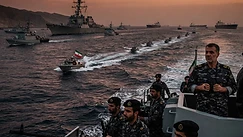
Tehran Outlines Formal Exclusion Zone Around Hormuz to Counter US Blockade
Iranian security officials have announced imminent plans to implement an operational maritime exclusion zone stretching from the U.S. naval blockade perimeter directly across the Strait of Hormuz.

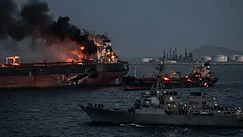
US Neutralizes IRGC Tankers off Kharg Island as Diplomatic Narrative Fractures
U.S. Central Command disabled three Iranian crude carriers over the weekend following IRGC missile launches against American warships, escalating the maritime conflict into its seventh month.

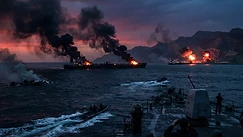
CENTCOM Destroys Iranian Tankers and Coastal Launch Sites as Tehran Claims Drone Intercepts
U.S. Central Command struck three Iranian oil tankers and pre-positioned coastal minelaying missile platforms, while Tehran claimed to strike an unmanned American naval vessel in contested Hormuz waters.