G7 Foreign Ministers Issue Urgent De-escalation Plea to Regional Actors
The Group of Seven nations issued a joint statement calling for restraint in the Middle East as the US military continues to reposition assets to defend against potential Iranian strikes.

Your ad here — 728×90 banner space
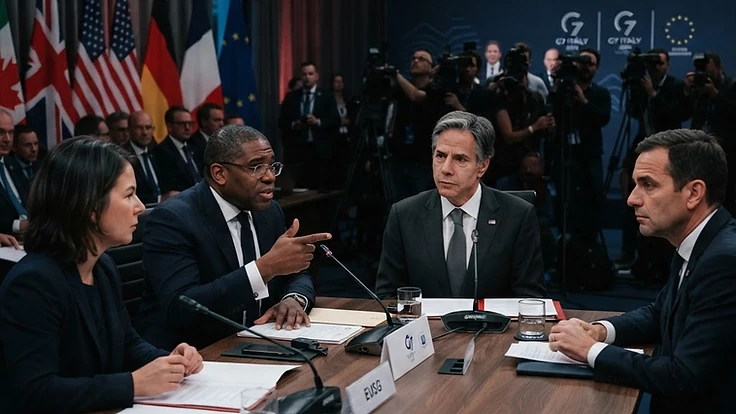
In a coordinated effort to prevent a full-scale regional war, foreign ministers from the Group of Seven (G7) nations—Canada, France, Germany, Italy, Japan, the United Kingdom, and the United States—held an emergency meeting to address the spiraling tensions between Iran and Israel. US Secretary of State Antony Blinken informed his counterparts that a combined attack by Iran and Hezbollah could begin within 24 to 48 hours, highlighting the extreme urgency of the situation. The G7 joint statement emphasized that 'all parties involved' must refrain from continuing the 'current destructive cycle of retaliatory violence,' warning that no country stands to gain from a further escalation in the Middle East. The diplomatic push is aimed at pressuring Tehran to calibrate its response to the killing of Ismail Haniyeh in a way that avoids triggering a broader conflict that could draw in US forces. Concurrently, the Pentagon has confirmed the deployment of additional missile-defense-capable cruisers and destroyers to the region, alongside the USS Abraham Lincoln carrier strike group, which is currently in transit. General Michael Erik Kurilla, commander of US Central Command (CENTCOM), arrived in the region on Sunday to coordinate with regional allies, including Jordan and Saudi Arabia, to ensure a cohesive defensive posture. Reports from Tehran indicate that Iranian officials remain divided on the scale of the response, with the Islamic Revolutionary Guard Corps (IRGC) pushing for a significant show of force while the newly inaugurated President Masoud Pezeshkian's administration explores the potential for a more symbolic strike to avoid total war. European mediators have been active in relaying messages between Washington and Tehran, emphasizing the potential for renewed economic sanctions and diplomatic isolation if Iran targets civilian centers or energy infrastructure. The Jordanian Foreign Minister, Ayman Safadi, conducted a rare visit to Tehran, the first by a senior Jordanian official in nearly two decades, carrying a message of neutrality and a plea for stability. As the diplomatic window narrows, the international community remains braced for a kinetic event, with many countries advising their citizens to leave Lebanon and Israel immediately. The G7's intervention represents a last-ditch effort to preserve the fragile status quo and prevent the collapse of ongoing negotiations for a Gaza ceasefire, which US officials maintain is the only sustainable path to lowering the regional temperature.
Related Intel

Tehran Outlines Formal Exclusion Zone Around Hormuz to Counter US Blockade
Iranian security officials have announced imminent plans to implement an operational maritime exclusion zone stretching from the U.S. naval blockade perimeter directly across the Strait of Hormuz.

US Neutralizes IRGC Tankers off Kharg Island as Diplomatic Narrative Fractures
U.S. Central Command disabled three Iranian crude carriers over the weekend following IRGC missile launches against American warships, escalating the maritime conflict into its seventh month.

CENTCOM Destroys Iranian Tankers and Coastal Launch Sites as Tehran Claims Drone Intercepts
U.S. Central Command struck three Iranian oil tankers and pre-positioned coastal minelaying missile platforms, while Tehran claimed to strike an unmanned American naval vessel in contested Hormuz waters.