Stealth Deterrence: F-22 Raptors Integrate into CENTCOM Command Amid Regional Threats
The arrival of U.S. Air Force F-22 Raptors in the Middle East marks a significant escalation in defensive posture intended to deter potential Iranian retaliation against Israel.

Your ad here — 728×90 banner space
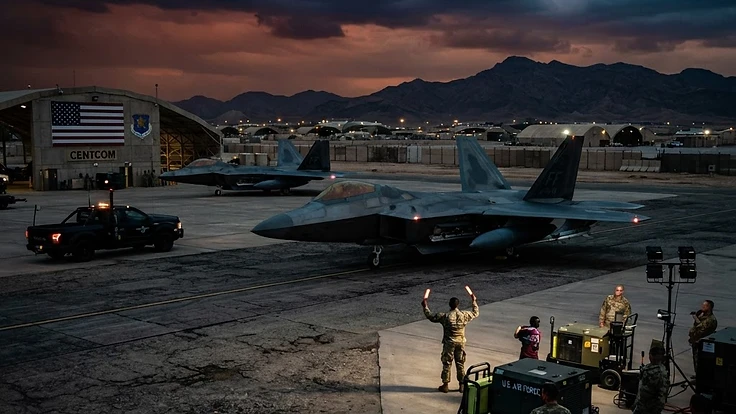
On August 8, 2024, U.S. Central Command (CENTCOM) confirmed the arrival of F-22 Raptor stealth fighters within its area of responsibility. This deployment is part of a broader tactical realignment ordered by Defense Secretary Lloyd Austin to mitigate the risk of regional escalation following the assassinations of high-ranking Hamas and Hezbollah officials in Tehran and Beirut. Approximately a dozen F-22s, originating from the 3rd Wing at Joint Base Elmendorf-Richardson in Alaska, completed a transit of over 5,600 nautical miles to reach the theater. The aircraft made a strategic stop at RAF Lakenheath in the United Kingdom before proceeding across the Mediterranean. While CENTCOM has not specified the exact airbase for operational security reasons, the presence of these fifth-generation fighters provides the U.S. with unmatched air superiority and sensor-fusion capabilities in a high-threat environment. The F-22 is specifically designed for air dominance, featuring stealth technology that allows it to operate within contested airspace while evading advanced integrated air defense systems (IADS). This capability is critical given Iran's recent rhetoric and the potential for multi-directional drone and missile swarms targeting Israeli or U.S. assets. Pentagon Press Secretary Maj. Gen. Patrick Ryder noted that the deployment is intended to improve U.S. force protection and increase support for the defense of Israel. Furthermore, the F-22s complement existing regional assets, including F-15E Strike Eagles, F-16 Fighting Falcons, and A-10 Thunderbolt IIs. The deployment comes as the U.S. Navy also repositions the USS Abraham Lincoln carrier strike group to accelerate its arrival in the region, alongside ballistic missile defense-capable cruisers and destroyers. Military analysts suggest the F-22's arrival serves as a psychological deterrent, signaling that any offensive action by Iran or its proxies could be met with a rapid, precision-strike response that is difficult to intercept. The logistical feat of moving a fighter squadron across the globe in less than a week underscores the agility of the U.S. Global Reach capability and its commitment to regional stability in the face of mounting geopolitical friction.
Related Intel


Tehran Outlines Formal Exclusion Zone Around Hormuz to Counter US Blockade
Iranian security officials have announced imminent plans to implement an operational maritime exclusion zone stretching from the U.S. naval blockade perimeter directly across the Strait of Hormuz.

US Neutralizes IRGC Tankers off Kharg Island as Diplomatic Narrative Fractures
U.S. Central Command disabled three Iranian crude carriers over the weekend following IRGC missile launches against American warships, escalating the maritime conflict into its seventh month.


CENTCOM Destroys Iranian Tankers and Coastal Launch Sites as Tehran Claims Drone Intercepts
U.S. Central Command struck three Iranian oil tankers and pre-positioned coastal minelaying missile platforms, while Tehran claimed to strike an unmanned American naval vessel in contested Hormuz waters.