White House Declares Hormuz International Waters Clear of Mines
President Trump asserts that U.S. Space Force monitoring has confirmed the removal of naval mines from key transit lanes.

Your ad here — 728×90 banner space
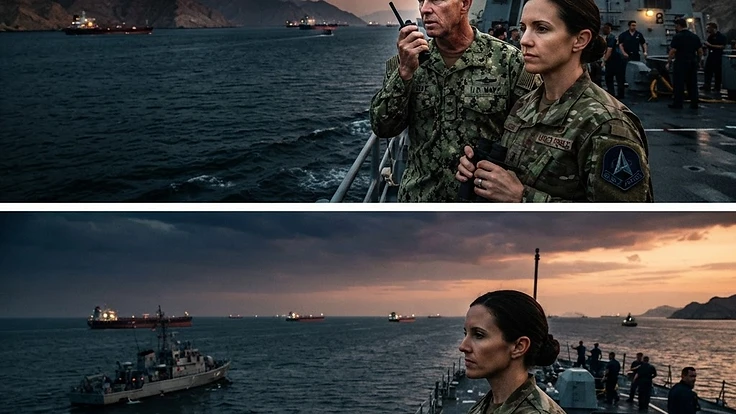
In a significant escalation of rhetoric regarding maritime safety, President Donald Trump announced today that international waters within the Strait of Hormuz have been cleared of naval mines. As reported by CNBC-TV18, the President claimed that all explosive devices previously laid by Iranian forces have been either detonated or removed. Trump emphasized that the U.S. Space Force is now utilizing advanced satellite technology to monitor 'every square inch' of the waterway, warning that any vessel caught attempting to re-mine the area would be 'destroyed immediately.'
This declaration is intended to reassure commercial shipping companies that have largely avoided the region since the conflict intensified in early 2026. However, the Iranian leadership has countered these claims with warnings of 'earthquake-like' retaliation if the U.S. continues its military and economic provocations. According to The Independent, Iran's new security chief has warned Gulf neighbors that they will be treated as 'enemies' if they cooperate with the U.S. blockade or the 'Economic D-Day' sanctions.
The technical feasibility of the U.S. claim remains a point of contention among naval experts. While the U.S. Central Command (CENTCOM) has maintained a heavy presence in the region, the sheer narrowness of the Strait—only 21 miles wide at its narrowest point—makes it highly susceptible to rapid re-mining by small, fast-attack craft. The U.S. Navy has reportedly deployed unmanned underwater vehicles (UUVs) to assist in the clearing operations, but the threat of 'sleeper' mines remains a primary concern for commercial captains.
Furthermore, the legal status of the Strait complicates the U.S. position. Iran maintains that the waterway falls under its sovereign management, a claim it has used to justify the imposition of 'service fees' and transit inspections. The U.S. declaration of 'clear waters' is seen by Tehran as an infringement on its territorial claims, further heightening the risk of a direct kinetic engagement. As the U.S. Space Force maintains its 24/7 surveillance, the world watches to see if commercial traffic will actually resume or if the 'clear' status is merely a psychological tactic in the ongoing war of nerves.
Related Intel

U.S.-Iran Diplomatic Impasse Persists Despite Regional Mediation Efforts
Diplomatic channels between Washington and Tehran remain largely stagnant as both sides hold firm on their respective conditions for a lasting ceasefire.
Basij Leadership Reasserts Control Over Strait of Hormuz
The head of Iran's Basij paramilitary unit has declared the Strait of Hormuz to be under Tehran's 'control and management,' complicating international efforts to restore free navigation.
Diplomatic Pulse: Iran and Oman Advance Interim Shipping Framework
Iran and Oman are finalizing an interim framework to resume shipping through the Strait of Hormuz, signaling a potential de-escalation in regional maritime tensions.