Strategic Maneuvers: Pentagon Deploys Carrier Strike Group to Middle East Amid Retaliation Threats
U.S. Defense Secretary Lloyd Austin has ordered the deployment of additional naval assets and fighter jets to the Middle East as Iran vows retaliation for the assassination of Ismail Haniyeh.

Your ad here — 728×90 banner space
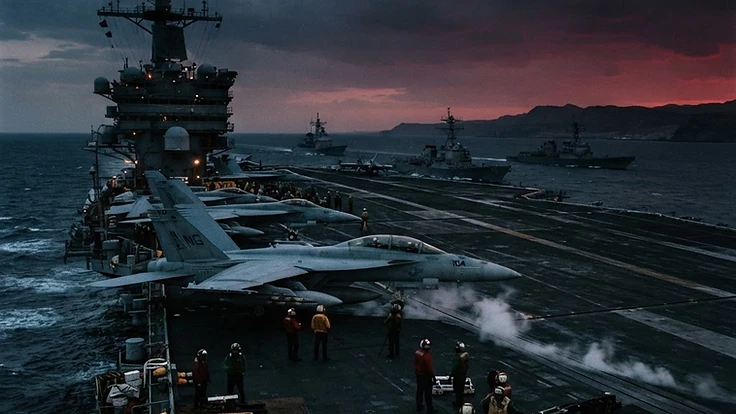
The U.S. Department of Defense has initiated a significant recalibration of its military posture in the Middle East, signaling an urgent effort to deter a regional conflagration. Secretary of Defense Lloyd Austin ordered the USS Abraham Lincoln Carrier Strike Group to replace the USS Theodore Roosevelt currently stationed in the Gulf of Oman. This move ensures a continuous carrier presence in the region, a critical component of the U.S. strategy to defend Israel and protect American personnel from potential strikes by Iran or its regional proxies. In addition to the carrier group, the Pentagon is deploying additional ballistic missile defense-capable cruisers and destroyers to the U.S. European Command and U.S. Central Command (CENTCOM) regions. The deployment also includes an unspecified number of land-based integrated air and missile defense systems, alongside a new squadron of advanced F-22 Raptor fighter jets. These maneuvers follow explicit threats from Tehran's top leadership. Supreme Leader Ayatollah Ali Khamenei has publicly stated that Iran has a 'duty' to avenge the death of Hamas political leader Ismail Haniyeh, who was killed in a sophisticated blast in Tehran shortly after attending the inauguration of President Masoud Pezeshkian. While Israel has not officially claimed responsibility for the Haniyeh assassination, it is widely attributed to Mossad operations. The U.S. military buildup aims to provide a 'flexible' response capability. Deputy Pentagon Press Secretary Sabrina Singh emphasized that these moves are 'not an escalation' but a defensive measure designed to mitigate the risk of a wider war. However, Iranian officials have characterized the U.S. presence as 'provocative,' suggesting that any intervention in an Iranian 'response' would make U.S. assets legitimate targets. Intelligence reports suggest that Iran may coordinate a multi-front attack involving Hezbollah in Lebanon, the Houthis in Yemen, and various militias in Iraq and Syria, mimicking the drone and missile swarm launched in April but potentially on a larger scale. The arrival of the USS Abraham Lincoln, equipped with F-35C Lightning II stealth fighters, provides the U.S. with enhanced strike and surveillance capabilities to counter such a coordinated effort. As of this morning, the USS Theodore Roosevelt remains in the vicinity of the Strait of Hormuz, maintaining a high state of readiness while the transition period begins.