Red Sea Environmental Crisis Looms as MT Sounion Remains Ablaze
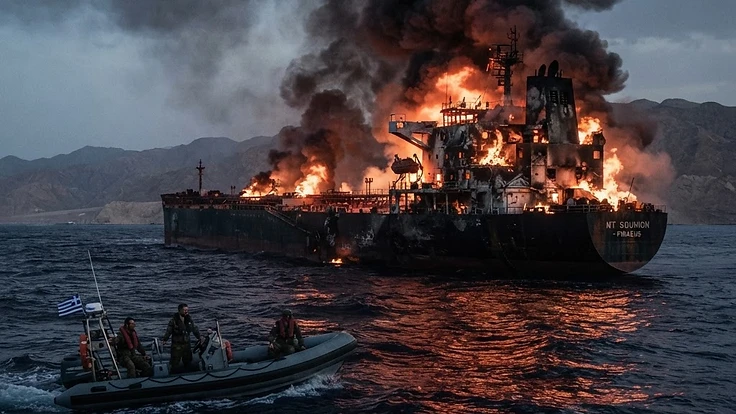
The Greek-flagged tanker MT Sounion, carrying 1.1 million barrels of crude, is currently on fire and adrift in the Red Sea following Houthi attacks.

Your ad here — 728×90 banner space
The maritime security situation in the Red Sea has deteriorated to a critical level as the Greek-flagged oil tanker MT Sounion remains adrift and on fire following a series of attacks by Houthi militants. On August 26, 2024, the European Union's naval mission in the region, Operation Aspides, confirmed that fires were observed on the vessel's main deck, likely resulting from explosives planted by the Houthi group after the crew had been evacuated. The vessel is currently carrying approximately 150,000 tonnes (1.1 million barrels) of Iraqi crude oil, posing a catastrophic environmental threat to the Red Sea ecosystem.
The MT Sounion was first targeted on August 21 by multiple projectiles approximately 77 nautical miles west of Hodeidah, Yemen. While the 25-member crew was rescued by a French destroyer, the vessel was left anchored in international waters. Subsequent footage released by the Houthis showed militants boarding the ship and detonating explosives. The U.S. State Department has condemned the attacks, noting that a spill of this magnitude would be four times larger than the 1989 Exxon Valdez disaster, potentially devastating the livelihoods of millions who depend on Red Sea fisheries and desalination plants.
For the Hormuz Sentinel Desk, this incident represents a significant escalation in the 'tanker war' dynamics. Unlike previous strikes intended to disable transit, the deliberate attempt to scuttle a fully laden VLCC (Very Large Crude Carrier) suggests a shift toward maximum economic and environmental disruption. The Houthis, who receive significant intelligence and hardware support from Tehran, have stated the attack is a response to the vessel owner's cooperation with Israel. However, the strategic consequence is a further tightening of the maritime insurance market. War risk premiums for Red Sea transits have remained elevated, and this latest incident is expected to drive more traffic toward the Cape of Good Hope, adding significant costs to global energy supply chains. Naval forces in the region are currently assessing the feasibility of a salvage operation, though Houthi threats against tugboats have complicated these efforts.