Maritime Risk Spikes Following Lethal Houthi Strike in Bab el-Mandeb
A fatal ballistic missile attack on a commercial vessel in the Bab el-Mandeb Strait has caused a sharp rise in maritime insurance premiums and forced further rerouting around the Cape of Good Hope.

Your ad here — 728×90 banner space
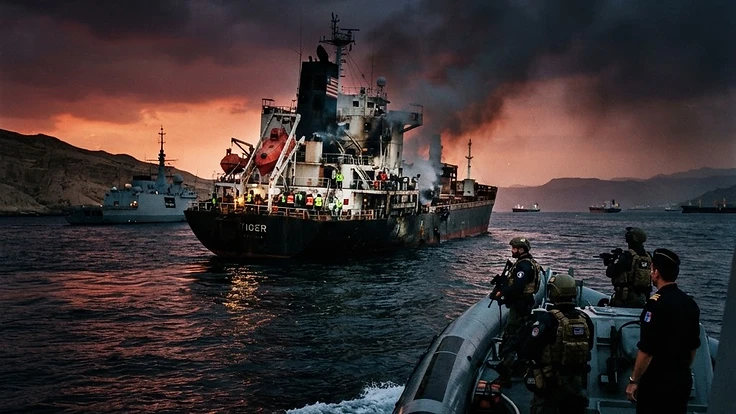
Maritime security across the Middle East’s primary chokepoints has reached a critical flashpoint following a deadly attack on August 13, 2026. According to the U.K. Maritime Trade Operations (UKMTO) and confirmed by Yemeni authorities, three Houthi ballistic missiles struck a commercial bulk carrier near the Bab el-Mandeb Strait. The attack resulted in the deaths of six crew members and left nine others injured, marking the deadliest maritime incident in the region this year.\n\nThe vessel, identified as the Liberian-flagged bulk carrier Tutor, suffered catastrophic stern damage and began taking on water before eventually sinking. Survivors, including Indonesian and Pakistani mariners, described a 'scene of doomsday' as they were evacuated by responding U.S. naval assets. The Houthis claimed responsibility for the strike, asserting the ship was targeted for violating their self-declared blockade on vessels linked to the Saudi-U.S.-Israeli axis.\n\nIn response to the escalation, maritime insurance premiums for transits through the Red Sea and Gulf of Aden have surged by as much as 40%, with some underwriters now refusing to cover vessels without private armed security details. The incident has also impacted shipping through the Strait of Hormuz, where tanker captains are increasingly adopting 'stealth' protocols—disabling Automatic Identification Systems (AIS) and requesting naval escorts. \n\nU.S. Central Command (CENTCOM) has reinforced its presence in the region, with the USS Mason and USS Laboon conducting active drone and missile interceptions daily. However, the use of low-cost, high-velocity 'hypersonic' variants by Houthi forces has strained current Aegis defense capabilities. Shipping conglomerates, including Maersk and Hapag-Lloyd, have issued updated advisories suggesting that diversions around the Cape of Good Hope will remain the operational standard for the foreseeable future, adding 10-14 days to transit times and significantly increasing global freight costs.