Escalation Threshold: Israel Security Cabinet Weighs Response to Golan Heights Strike
Following a deadly rocket strike in the Golan Heights, the Israeli Security Cabinet has authorized a military response, heightening fears of a full-scale war with Hezbollah.

Your ad here — 728×90 banner space
Regional Tension Peaks Following Majdal Shams Incident
The Israeli Security Cabinet, led by Prime Minister Benjamin Netanyahu and Defense Minister Yoav Gallant, has officially authorized the government to determine the 'manner and timing' of a response to Saturday's rocket attack on the Druze town of Majdal Shams. The strike, which killed 12 children and teenagers at a football pitch, has been attributed to Hezbollah by both Israeli intelligence and the United States, although the Lebanese militant group has issued a rare denial of responsibility.
Strategic Decision Making in Tel Aviv
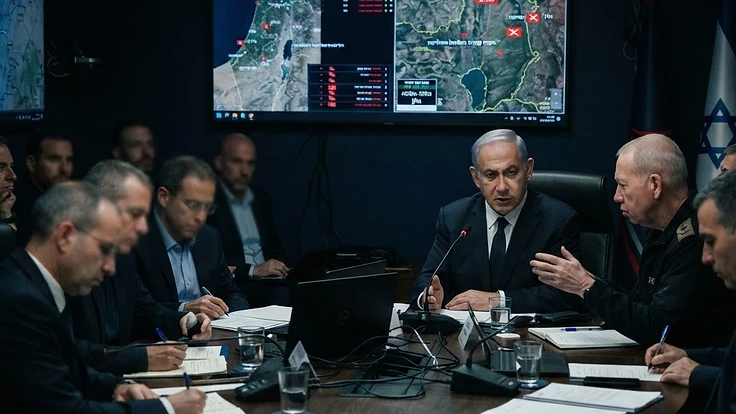
Returning early from a visit to the United States, Prime Minister Netanyahu convened the cabinet at the Kirya military headquarters in Tel Aviv on Sunday evening. According to official statements from the Prime Minister’s Office, the cabinet members were briefed on several operational plans developed by the IDF (Israel Defense Forces) and the Mossad. The objective of the meeting was to establish a threshold for retaliation that would restore deterrence without necessarily triggering a total regional conflagration involving Iran.
However, the rhetoric from Israeli officials remains uncompromising. Defense Minister Gallant stated that the strike 'will not go unpunished' and emphasized that Hezbollah will 'pay a heavy price' for the bloodshed. IDF Spokesperson Rear Admiral Daniel Hagari confirmed that the rocket was a Falaq-1, an Iranian-made projectile carrying a 50kg warhead, launched from a site north of the village of Chebaa in southern Lebanon.
The Role of Iran and the 'Ring of Fire'
Tehran has warned Israel through diplomatic channels that any 'new adventure' in Lebanon could lead to 'unforeseen consequences.' Iranian Foreign Ministry spokesperson Nasser Kanaani cautioned that the Zionist regime would be responsible for the 'catastrophic' outcome of an expanded conflict. For Tehran, Hezbollah remains the crown jewel of its 'Axis of Resistance,' and any significant degradation of the group’s capabilities is viewed as a direct threat to Iranian strategic depth.
US intelligence officials are reportedly working through backchannels in Beirut and Muscat to urge restraint. The White House National Security Council reaffirmed its 'ironclad' support for Israel's security while simultaneously emphasizing that a diplomatic solution along the Blue Line is the only way to ensure long-term stability for residents on both sides of the border.
Military Posture and Civilian Readiness
The IDF has already begun shifting assets toward the Northern Command. Reservist units have been placed on high alert, and the Israeli Air Force has increased its combat air patrols over southern Lebanon and the Bekaa Valley. On the Lebanese side, reports indicate that Hezbollah has evacuated several key command centers in the Dahiya district of Beirut and shifted long-range missile batteries into more secluded positions in anticipation of a multi-day Israeli aerial campaign. Analysts suggest that the next 24 to 48 hours will be critical in determining whether the conflict remains contained to the border regions or expands into a broader theater of war that could draw in Iranian-backed militias from Iraq and Syria.