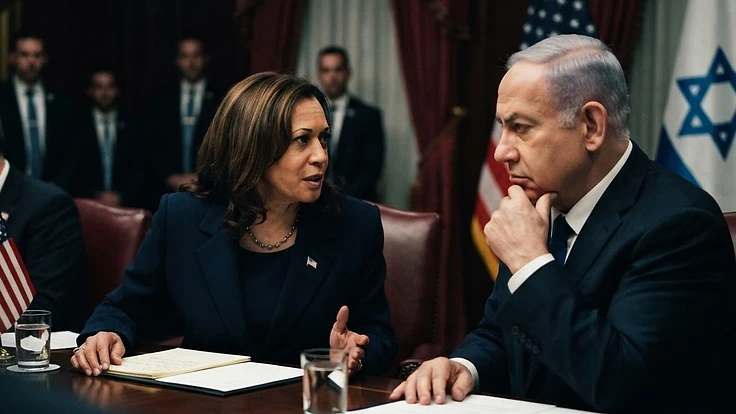
Diplomatic Pressure: Harris Confronts Netanyahu Over Gaza Humanitarian Crisis
Vice President Kamala Harris issued a pointed call for a ceasefire following meetings with Prime Minister Netanyahu, highlighting a potential rhetorical shift in US-Israel relations.

Your ad here — 728×90 banner space
In a meeting that has drawn intense international scrutiny, Vice President Kamala Harris delivered a stern message to Israeli Prime Minister Benjamin Netanyahu on Thursday, July 25, 2024, emphasizing that she 'will not be silent' regarding the humanitarian suffering in Gaza. The meeting followed Netanyahu's address to a joint session of Congress and signaled a potential recalibration of the Biden-Harris administration's public stance as the conflict enters a critical phase. Harris, who is currently the presumptive Democratic nominee for the 2024 presidential election, balanced her support for Israel's right to defend itself with a blunt assessment of the civilian toll. During her public remarks, she stated that the scale of human suffering, including the displacement of nearly two million people and the threat of famine, is devastating. Factual reports from the U.S. State Department and international aid agencies indicate that humanitarian corridors remain constricted, despite Israeli assurances of expanded access. Analysts suggest that Harris's tone reflects growing domestic pressure within the United States and a desire to see a swift conclusion to the Hostage Release and Ceasefire Agreement currently on the table. The proposal, mediated by the United States, Egypt, and Qatar, aims to secure the release of hostages held by Hamas in exchange for a multi-week cessation of hostilities and the entry of significant aid into the enclave. Netanyahu’s visit to Washington comes at a time of extreme regional tension, with Iran-backed proxies, including Hezbollah in Lebanon and the Houthis in Yemen, continuing to engage in escalatory actions. The Israeli Prime Minister is scheduled to meet with former President Donald Trump at Mar-a-Lago on Friday, a move seen as an attempt to shore up bipartisan support and navigate the shifting political landscape in Washington. For Tehran, the perceived daylight between U.S. leadership figures offers a strategic opening to exploit diplomatic fissures, though the underlying U.S. commitment to Israeli security through military aid and intelligence sharing remains largely intact. The coming days will be pivotal as negotiators attempt to bridge the remaining gaps in the ceasefire proposal, with the U.S. administration pushing for a 'Phase One' implementation that could stabilize the northern border with Lebanon and reduce the risk of a broader regional conflagration involving Iran directly.
Related Intel


Diverging Transit Estimates Expose Fog of War Across Middle East Energy Routes
Conflicting transit claims from Washington and maritime tracking services underscore how information warfare has become central to energy price discovery.
Dual Blockade Dynamics and War Risk Premiums Paralyze Hormuz Commercial Vessel Throughput
Structural maritime paralysis grips the Persian Gulf as war-risk insurance premiums reaching eight percent combine with active minelaying to throttle baseline throughput.
Strait Risk Matrix Elevates as Daily AIS Transits Compress to Low Single Digits
Real-time maritime tracking indicates commercial vessel transits through the Strait of Hormuz have collapsed to historic lows, with only four active merchant hulls tracked along the primary corridor.