Diplomatic Deadlock: G7 Urges Middle East Restraint as Blinken Warns of Imminent Strike
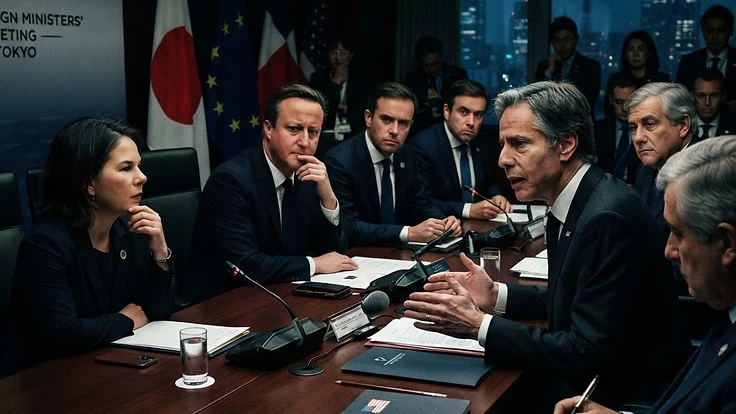
U.S. Secretary of State Antony Blinken has informed G7 counterparts that an Iranian and Hezbollah response could begin within 24 to 48 hours, prompting a flurry of last-minute diplomacy.

Your ad here — 728×90 banner space
The G7 nations issued a collective plea for 'restraint and de-escalation' in the Middle East following a crisis call convened by U.S. Secretary of State Antony Blinken. During the conference, Blinken reportedly informed his counterparts that Washington believes an Iranian-led retaliation against Israel is imminent, potentially occurring in a 24-to-48-hour window. The intelligence assessment suggests a multi-pronged attack involving both Tehran and its regional proxies, specifically Hezbollah in Lebanon and the Houthi movement in Yemen.
Blinken emphasized that the United States is working 'around the clock' to limit the scope of the attacks and prevent the outbreak of an all-out war. 'We are engaged in intense diplomacy, pretty much around the clock, with a very simple message: All parties must refrain from escalation,' Blinken stated during a meeting with Australian Foreign Minister Penny Wong. The U.S. strategy currently follows a dual-track approach: hardening defenses through the deployment of the USS Abraham Lincoln carrier strike group and additional F-22 Raptor squadrons, while simultaneously pressuring regional partners to convince Tehran that a massive strike would be counterproductive to its long-term interests.
However, the diplomatic leverage appears to be waning. Iranian officials have publicly rebuffed calls for moderation, with the Foreign Ministry stating that while Tehran does not seek regional instability, it has a 'legal right' to punish Israel to deter future violations of its sovereignty. The G7 statement expressed 'deep concern' over the heightened level of tension and urged all involved parties to 'break the current negative cycle of retaliatory violence.'
Middle East analysts at the Hormuz Sentinel Desk observe that the current diplomatic vacuum is being filled by military posturing. Unlike previous escalations where back-channel communications provided a clear off-ramp, the current rhetoric from the Islamic Revolutionary Guard Corps (IRGC) suggests a desire to restore deterrence through a more forceful kinetic display than the April 13 drone and missile barrage. The absence of a clear diplomatic breakthrough suggests that the regional security environment is now dictated by tactical military decisions rather than political maneuvering.
Related Intel

Diverging Transit Estimates Expose Fog of War Across Middle East Energy Routes
Conflicting transit claims from Washington and maritime tracking services underscore how information warfare has become central to energy price discovery.
Dual Blockade Dynamics and War Risk Premiums Paralyze Hormuz Commercial Vessel Throughput
Structural maritime paralysis grips the Persian Gulf as war-risk insurance premiums reaching eight percent combine with active minelaying to throttle baseline throughput.
Strait Risk Matrix Elevates as Daily AIS Transits Compress to Low Single Digits
Real-time maritime tracking indicates commercial vessel transits through the Strait of Hormuz have collapsed to historic lows, with only four active merchant hulls tracked along the primary corridor.